



April 12, 2016
The efforts put by telecommunication equipment manufacturers have spanned the years with the aim to develop higher-bandwidth-delivering products, so as to better accommodate the users’ needs. Admittedly, the past several years have witnessed the increased adoption of 10G network links among enterprises and organizations. But no one is able to predict the fast growing rate of network bandwidth, whose primary booster is the increasing numbers of broadband subscribers coupled with the growing number of online users accessing video-on-demand sites. 10G network infrastructure can’t meet the users’ demands for higher bandwidth well. As such, the need for dense 40 Gigabit Ethernet (GbE) infrastructure is necessary.
40GbE infrastructure allows link aggregation, simplifying the data network topology by bonding multiple lower speed lanes. However, the migration path from 10G to 40G, in no case, is free from thistles and thorns. Some difficulties may occur. But don’t worry. This text lists migration challenges and the corresponding solutions.
The following paragraphs detail four challenges met by users while moving from 10GbE to 40GbE network infrastructure.
- Increase in Cost
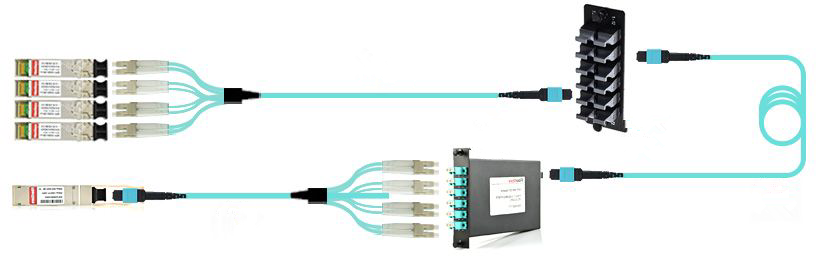
The first challenge comes to the cost. Migration to 40G isn’t a cost0saving project. The price of a 40G link is expensive than that of 4*10G links (as shown in the figure below). The 40G equipment that bridges applications and switching solutions for 40G is a main factor that causes the increase in budget. For instance, a QSFP transceiver, like QFX-QSFP-40G-SR4, a 40GBASE-SR4 QSFP+, is much more expensive than a 10GBASE-SR SFP+(eg. F5-UPG-SFP+-R), that is almost five times judging from the average market price.
- Drop in Optical Signal to Noise Ratio (OSNR)
The second one goes to the drop in OSNR. A unit of information, called a symbol, transmitted at 10Gbit/s takes 100 pico seconds (100ps), and the same symbol transmitted at 40Gbit/s takes 25ps. This means the receiver translating the light back into a symbol deals with only 25% of the light of a 10G symbol. It causes 6 dB OSNR to drop. The OSNR is a measure of the strength of the signal. So the drop of 6dB means the link length will be decreased by 75%.
- Increase in Chromatic Dispersion (CD)
When a signal travels through a fiber, CD causes the pulses constituting the signal to spread in time. If this spreading is not compensated, these pulses will overlap. It means the signal is unusable. Comparing to 10G, this effect is 16 times more obvious at 40G. This creates a serious roadblock for 40G system operating.
- Increase in Polarization Mode Dispersion (PMD)
PMD is the third problem which may be the most difficult to solve. This occurs due to infinitesimal imperfections in the circularity of the core of a fiber, which may be caused by the material itself, manufacturing process, or stress in the field created by bending or twisting. PMD is more capricious than predictable, and is very dependent on the qualities of the fiber. PMD can be influenced by factors including cable age or vintage, temperature of cable, cable design and cable manufacturer, etc.
Although migration from 10G to 40G encounters some difficulties mentioned above, several modulation schemes and approaches have been developed.
- About Cost Savings
40G migration requires the use of new equipment. As mentioned above, some optical equipment like transceivers from Google searching result are quite expensive. In order to save money, you can consider the third-party suppliers, such as Fiberstore, whose fiber optical products, including fiber optic transceivers and cables, are quality assured and fully compatible with major brands. Besides, these compatible products are sold at really low prices. For example, the price of QFX-QSFP-40G-SR4 listed in Fiberstore is just US$ 85.00 and F5-UPG-SFP+-R is US$ 16.00.
- About OSNR, CD, PMD Improvements
On one hand, problems related to OSNR, CD and PMD are directly caused by optics, the fiber quality and other optical equipment. So it’s highly recommended choose high quality equipment. On the other, such conditions also have relation to fiber optical technology. When 40G technology becomes maturer and maturer, simplified materials can be designed, and better solutions can be put forward.
With the increasing demands for higher-bandwidth applications, the trend of migration from 10G to 40G is inevitable. With the above methods migration challenges and solutions, you can upgrade to 40G network efficiently. Besides, to help customers achieve 40G smoothly, Fiberstore provides various 40G fiber optics products with high quality at lower prices. For more information about 40G solutions, please visit Fiberstore with no hesitation.
Posted by: fernxu123 at
03:00 AM
| No Comments
| Add Comment
Post contains 759 words, total size 6 kb.
35 queries taking 0.0579 seconds, 80 records returned.
Powered by Minx 1.1.6c-pink.

